On Objects
What a Hinge Tells You
Marketing is written. A mechanism is engineered. The part of an object that moves is the part that cannot lie about how much thought went into it.

Every object has one part that copywriting cannot rescue. Not the finish, not the box, not the sentence on the front of it. The part that moves.
A hinge, a magnet, a detent, a catch. Anything that has to behave the same way on the thousandth use as it did on the first. You can photograph a bad hinge beautifully. You cannot fake one in the hand.
A fold that has to be a fold
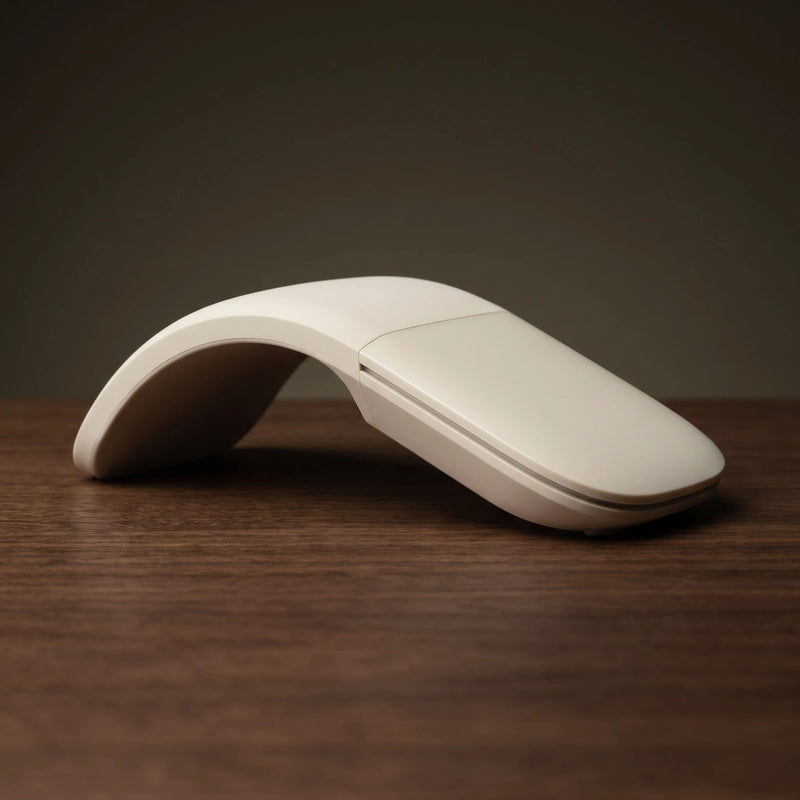
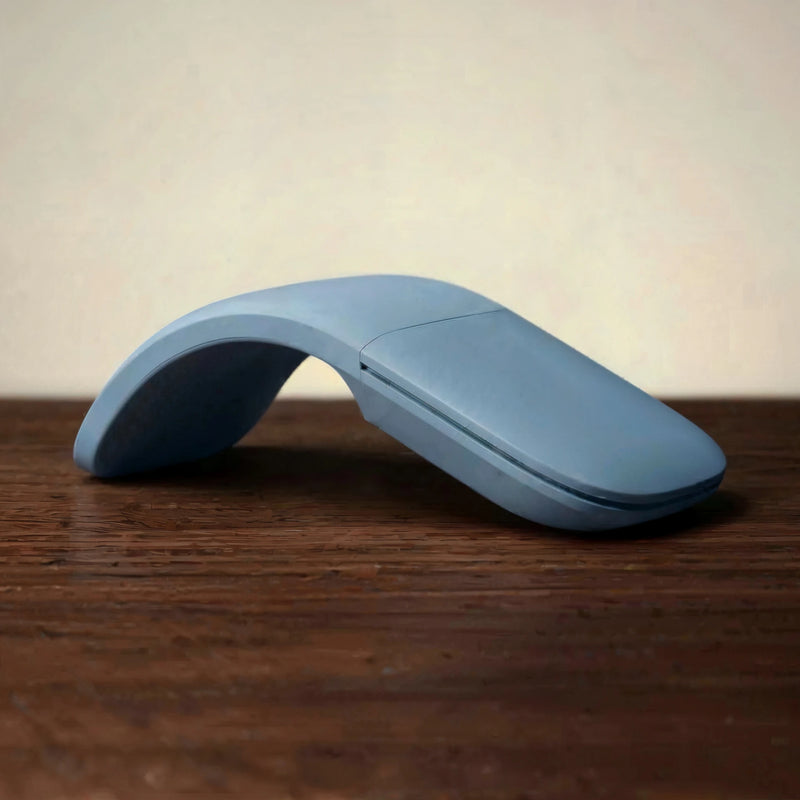
Our folding mouse lies flat at 0.6 in (14.5 mm) and weighs about 2.9 oz (82 g). Flat, it disappears into a laptop sleeve. Bent into its curve it becomes a mouse, and the act of bending is what switches it on. There is no power button to find, and none to leave switched on in a bag.
That is one seam doing three jobs: shape, on, off. It is also the first thing a cheaper version would compromise. A hinge like that has to hold two positions cleanly, come back to the same geometry every time, and survive being flexed twice a day for years. Done badly, it becomes a piece of plastic that slowly stops caring which position it is in.
The honest limit of the design sits right next to its best trick. Nothing can protrude from a body that folds flat, so the scroll wheel is replaced by a touch strip. Buyers describe it accurately. It is a simple vertical scroll, good for reading, less good in a spreadsheet, and it takes about a week to stop reaching for a wheel that is not there. That is the trade the mechanism forces, and we would rather you knew it before the box arrives.
A magnet that knows where it is
Our folding charging stand makes a quieter argument. It collapses into a flat panel, and the part doing the work is not the hinge. It is the magnet.
Alignment is the real problem with wireless charging. The coils have to line up. A flat pad asks you to line them up yourself, in the dark, half asleep, and punishes a near miss with a phone sitting at 40 percent in the morning. A magnetic ring moves that job from you to the object, which is what good design usually looks like: someone decided to take a small chore off your list.
The rest of the stand follows the same logic. A dedicated point for a watch, up to 3W. A resting pad on the base for an earbuds case, up to 5W. Three devices, one folded object, no evening cable hunt.
And the footnote we put in the FAQ as well, because it is the kind of thing people find out too late: no power supply comes in the box. The stand expects a 45W class USB-C charger, the sort most people already own. Including one would have made it thicker, heavier and dearer, so the design does not.
Three questions we ask of a mechanism
Does it return? A good mechanism lands in exactly the same place every time. That repeatability is what makes an object feel expensive, far more than the material does.
What happens at the seam after a year? Hinges rarely fail suddenly. They get vague. Which is why, when we read reviews, one written six months in is worth ten written on delivery day.
Is it solving something real? This is where most clever mechanisms die. Folding is only a virtue if the thing actually travels. A magnet only earns its cost if you charge in the dark, in a hurry, without looking.
Open and close the thing ten times in a row. Not once. On the tenth cycle you will feel whether the movement is engineered or merely possible, and you will know more than any spec sheet can tell you.
Where mechanisms go wrong
The failure is rarely dramatic. A joint develops play. A magnet is strong on the shelf and too weak once a case is on the phone. A stand holds a laptop perfectly until somebody types hard.
What those have in common is that none of them show up in a photograph, and all of them show up around day sixty. It is exactly why the reviews we pay most attention to are the boring ones with a date attached.
Read the moving part first
If you take one habit from this, take that one. Before the feature list, find the part that moves and ask what it would cost to do properly. It tells you more about a company's priorities than any amount of copy, ours included.